
About DKP-ADS
Why DKP-ADS?
Staple crops serve as the primary food source globally, and their stable supply is crucial for maintaining food security. However, crop diseases significantly reduce the yield of these crops, not only impacting the economic returns of agricultural producers but also potentially leading to food crises, which can affect social stability. Facing crop diseases, farmers often struggle to identify and respond to them promptly and accurately due to a lack of specialized diagnostic skills, further exacerbating the problem. Therefore, achieving precise identification and severity assessment of plant diseases is essential for optimizing pesticide dosage, reducing environmental impacts, and protecting ecological balance.
Current studies for assessing crop disease severity are mainly divided into classification-based and segmentation-based methods. As shown in Figure 1 (a), traditional classification models to assess disease severity rely on a large amount of training data and are primarily judged by feature extraction and classification, but lack the ability to accurately quantify the extent of disease impact (EG, lesion area), as a result, there are limitations in quantifiability and cost-effectiveness. As shown in Figure 1 (b), although the traditional segmentation model can quantitatively assess the proportion of disease areas, it still requires a large amount of high-quality segmentation data training, resulting in a complex, time-consuming and costly data acquisition and annotation process, which affects its cost-effectiveness in practical applications. Therefore, we propose a large model grade framework based on expertise-driven, illustrated in Figure 1 (c), employs a large-scale model-based disease severity assessment scheme.
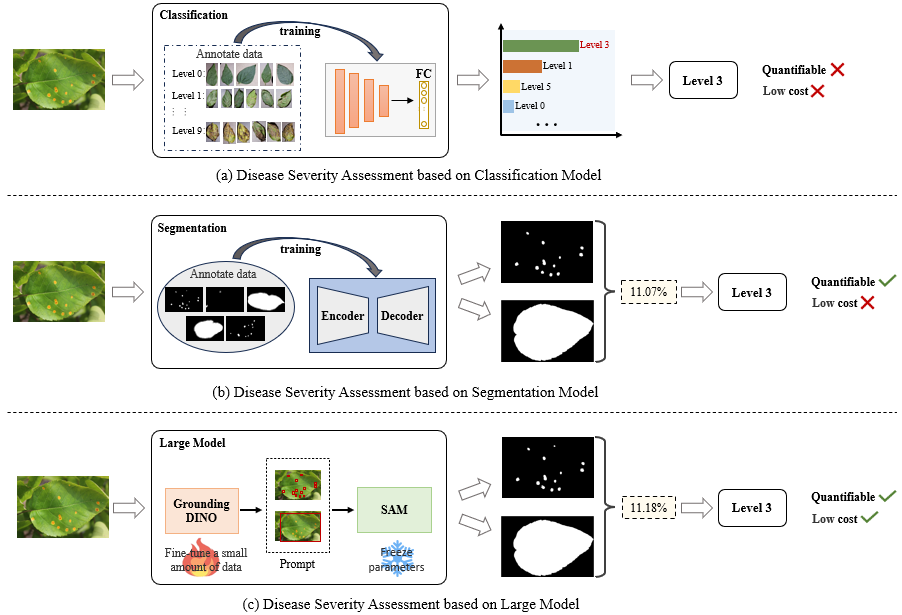
Figure 1: Comparison of several methods for disease severity assessment. (a)Disease Severity Assessment based on classification model. (b) Disease Severity Assessment based on Segmentation Model. (c) Disease Severity Assessment based on Large Model. “Quantifiable” means that disease severity can be evaluated numerically. “Low cost” means that the training model has less data and takes less time.
Testing of Non-staple Crops
To observe the effectiveness of our study method in disease assessment on other crops, we test our DKP-ADS on two non-staple crops, as shown in Figure 2. We conduct tests on apple and tomato crops and displayed the segmentation results of leaves and diseased areas. The results show that the leaf segmentation performance is excellent for both crops, as leaves are relatively easier to segment compared to diseased areas. Specifically, DKP-ADS performs well in segmenting diseased areas on apples because their diseased spots are typically simple, often appearing as "spot lesions," making them easier for our method to segment effectively. In contrast, the segmentation of diseased areas on tomatoes is less effective, especially those located at the edges of the leaves, which DKP-ADS could not accurately identify and segment. Finally, based on the visualization of the segmentation results, it is evident that DKP-ADS demonstrates good generalization capabilities. Despite being built primarily for staple crops, it still performs well on other types of crops, proving its potential for future applications.
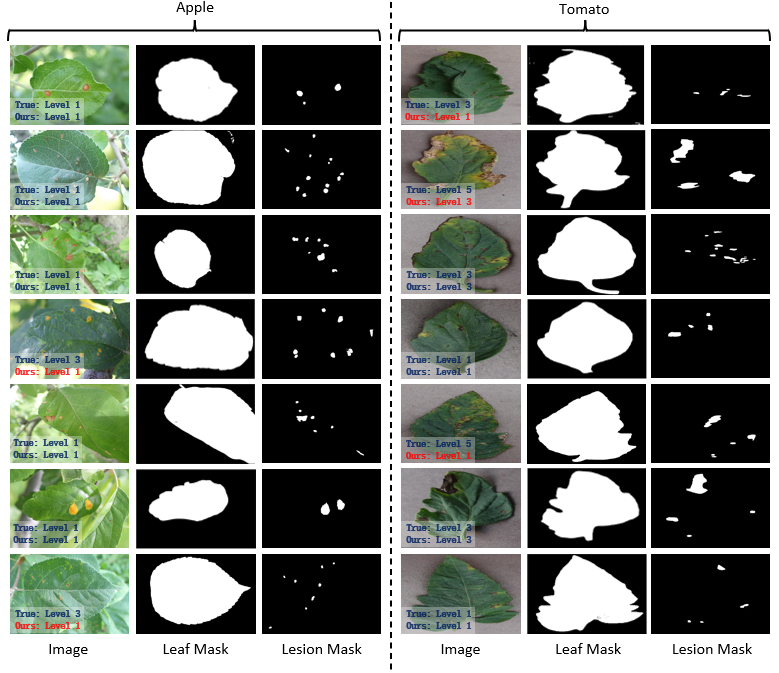
Figure 2: Segmentation renderings of DKP-ADS on non-staple crops. We test it on apple and tomato crops, demonstrating the segmentation performance of our method on non-main crops. The original image shows the true severity level and our method's estimated severity level for each image, with red font indicating prediction errors.
Future Application
To apply our research in practical scenarios, our disease grading system can play a significant role in real-time field monitoring, smart decision-making, and other areas. First, as shown in Figure 3 (a), we can utilize Internet of Things (IoT) technology and wireless sensor networks to achieve real-time monitoring of field environments. Combined with the DKP-ADS grading strategy, the system can promptly detect diseases and issue warnings, helping farmers take preventive measures and reduce crop losses due to diseases. Real-time monitoring data can continuously be fed back into the model, enabling online learning and adaptive adjustments, which further enhance the robustness and generalization capability of our grading system. Additionally, as shown in Figure 3 (b), our research can support precision agriculture and smart decision-making. Based on our disease grading results, combined with agricultural expert systems and decision support tools, agricultural practitioners can obtain more scientific recommendations for disease control. This allows for precise pesticide application on specific crops and disease categories, reducing pesticide usage, optimizing planting management and resource allocation, and improving crop yield and quality.
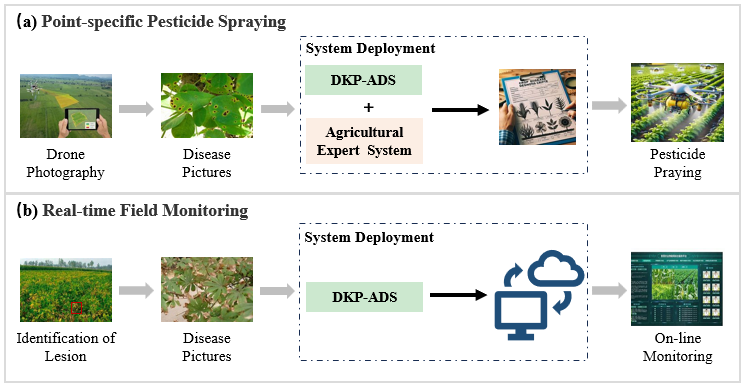
Figure 3: Future applications of disease classification systems. (a) Point-specific Pesticide Spraying, DKP-ADS can be combined with agricultural expert systems to achieve precise prevention and control of diseases. (b) Real-time Field Monitoring, DKP-ADS can be connected to the Internet to achieve real-time monitoring of diseases.
Research Team
SAMLab